
Why Long-Duration Storage Can’t Get Financed in the US
The short answer: US capacity markets say they want 8, 10, even 12-hour storage — then systematically underpay for it. The gap sits in three places: how duration is accredited, how long contracts run, and where price caps sit.
Ahead of the Battery Asset Management Summit (BAMS) in Garden Grove, California, Raafe Khan — head of energy storage at Camelot Energy — laid out the financing problem in unusually blunt terms. The structural design of US capacity markets, he argues, is why long-duration storage (LDES) keeps getting praised in policy circles and skipped in procurement.
1. Accreditation: double the duration, 12% more credit
Capacity markets credit a resource through ELCC (Effective Load Carrying Capability). In PJM’s latest auction, a 4-hour battery was credited at 59%, a 6-hour at 68%, and an 8-hour at just 71%. Doubling duration from 4 to 8 hours added 12 percentage points of credit while nearly doubling system cost. When the credit curve flattens at the same rate the cost curve climbs, incremental revenue simply cannot cover incremental investment.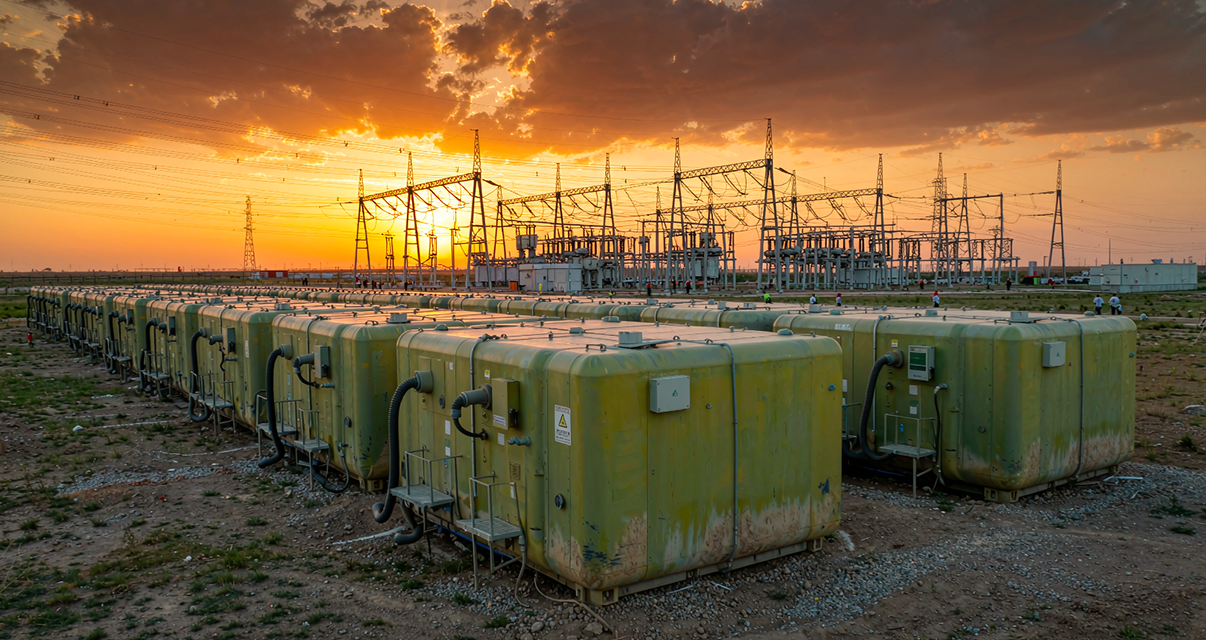
Grid-scale long-duration storage: capital-intensive, built for 20+ years — and still waiting for contracts that match.
2. Term length: a 3-year contract on a 25-year asset
Auctions typically award 1- to 3-year commitments. These assets are designed to run 20 to 25 years. For what is genuinely core infrastructure, developers need a longer tenor; short windows force owners back into the market every few years to re-qualify and re-certify before well-performing assets are recognized at all.
3. Price caps: the signal arrives too late
PJM applies an administrative cap on capacity prices. It has been hit in each of the last three auctions, most recently around $325 per MW-day. When scarcity triggers the cap, price can no longer guide investment toward a specific duration or scale — precisely at the moment the signal matters most.
Market design, not hardware, decides whether long-duration storage earns a bankable revenue curve.
4. Data centers are a catalyst, not the foundation
Khan describes storage serving data centers as a marginal-margin game: behind-the-meter batteries sell time to market rather than energy, with the real anchor being the opportunity cost of a delayed interconnection, not LCOS. The underlying structural driver is still arbitrage on midday price troughs created by large-scale solar and wind buildout. On sodium-ion, his read is equally sobering — a cost hedge against lithium, not a genuine long-duration solution.
5. Where non-lithium actually wins
Beyond 10 to 12 hours, with only 100 to 200 cycles a year and revenue based on availability, lithium’s cycle-life advantage loses relevance: cost is dominated by energy cost, traded against lower round-trip efficiency. In the 8- to 12-hour band, operating life matters more — compressed air storage targets 50 years against 20 to 25 for lithium, which rewrites the LCOS math entirely. At 4 hours, lithium still owns the segment, but non-flammability is the wedge: next to a high-value data center, insurability carries more weight than pure cost.
6. The UK shows what better design looks like
For an 8-hour system, PJM accredits roughly 71% versus about 84% in the UK. The larger gap is contract length: 1 to 3 years under PJM against up to 15 years in the UK. Longer tenors are what turn a capital-intensive asset into a financeable one.
Our take | moPower

The real question is not which technology is best — it is whether market design can convert value into cash flow. For buyers, bankability has shifted from headline capex to 20-year lifetime value: verified safety, measurable degradation data, and a service life you can defend to a lender. At moPower, 15 years of battery expertise and disciplined ISO manufacturing go into cells and systems built to keep earning across a full asset life.

Sizing storage for a 20-year asset life? Talk to our team about cells, systems and compliance → https://mopower360.com/contact
FAQ
Q: What is ELCC and why does it cap long-duration storage revenue?
A: ELCC (Effective Load Carrying Capability) measures how much firm capacity a resource can reliably contribute at system peak. In PJM’s latest auction, a 4-hour battery received 59%, a 6-hour 68%, and an 8-hour just 71%. Doubling duration added only 12 percentage points of credit while nearly doubling system cost, so the incremental revenue cannot cover the incremental investment.
Q: What are the three structural gaps in US capacity markets?
A: First, accreditation: ELCC discounts duration too steeply, leaving 8-hour systems at 71%. Second, term length: auctions award only 1-3 year commitments against assets built to last 20-25 years. Third, administrative price caps: PJM’s cap was hit in each of the last three auctions, most recently around $325 per MW-day, muting the price signal exactly when scarcity should drive new investment.
Q: Is data center demand the real driver of long-duration storage?
A: No. Data centers act as a catalyst rather than a foundation. Behind-the-meter storage sells time to market rather than energy, with the anchor being the opportunity cost of a delayed interconnection, not LCOS. The true structural driver remains arbitrage on midday price troughs created by large-scale solar and wind buildout.
Q: When do non-lithium long-duration technologies win on economics?
A: Two main cases. Beyond 10-12 hours with only 100-200 cycles per year and availability-based revenue, lithium’s cycle-life advantage loses relevance, energy cost dominates, and the trade-off becomes lower round-trip efficiency. In the 8-12 hour band, operating life matters more: compressed air storage targets 50 years versus 20-25 for lithium, which rewrites the LCOS calculation.
Q: How does the UK capacity market compare with the US?
A: For an 8-hour system, PJM accredits roughly 71% while the UK accredits about 84%. The bigger difference is contract length: PJM awards 1-3 years, whereas UK agreements can extend up to 15 years. Longer tenors materially improve the bankability of capital-intensive, long-lived assets.
Q: What should equipment buyers watch as these markets evolve?
A: Bankability is shifting from headline capex to 20-year lifetime value: verified safety, measurable degradation data, and long service life. Buyers should ask for certified safety testing, transparent state-of-health telemetry, and a manufacturing partner whose processes hold up over the asset’s full operating life.