Stay Cool and Get Paid: What a 1,000-Home Battery Experiment in New York Tells Us About the Future of Home Energy
For years, demand response programs have asked homeowners to do one uncomfortable thing: sweat through it. When the grid strains during a heatwave, your utility essentially pays you to switch off the air conditioner and wait for the peak to pass. This summer, around 1,000 households in New York City did the opposite. They kept their AC running, kept their apartments cool, and still collected the rebate. The trick was a home battery.
The New York Pilot, in Plain Terms
A startup called Every Electric delivers a battery to your door at no cost. You plug it into a standard wall outlet, then plug your window air conditioner into the battery. On the hottest days — when a “heat dome” pushes temperatures past 100°F and the grid is at its limit — the AC draws power from the battery instead of the grid. That counts as reducing demand under utility Con Edison’s demand response program, so participating households earn bill credits without giving up comfort.
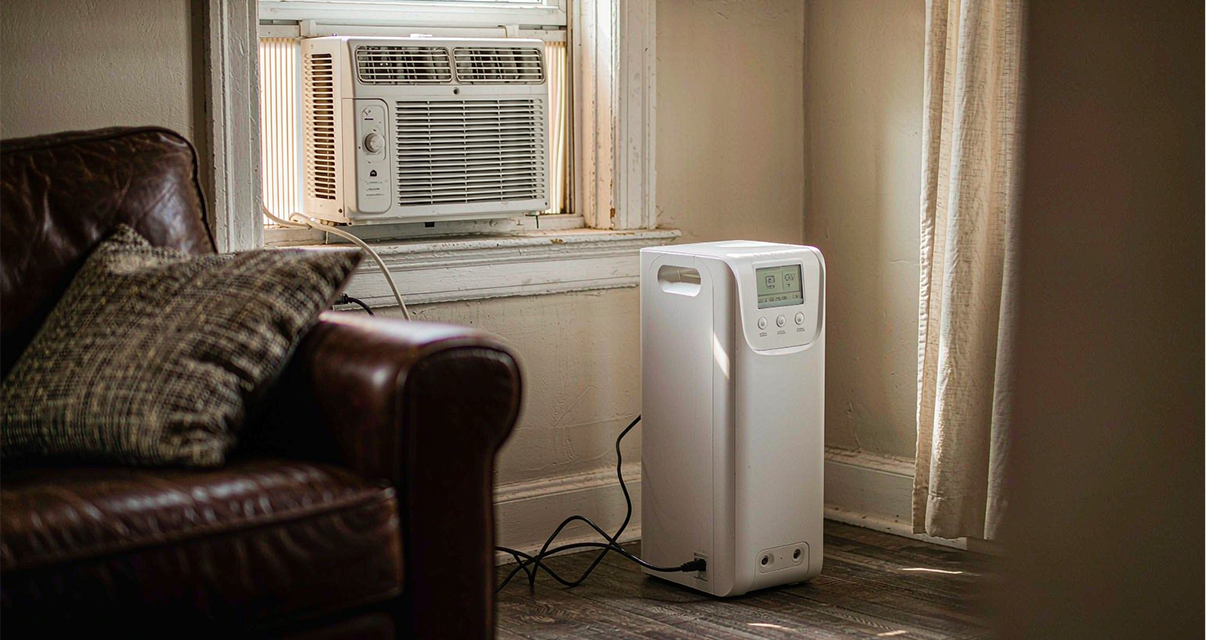
Participating households plug window AC units into a battery instead of the wall socket during peak hours.One participating family told Ars Technica they had spent four summers pre-cooling their apartment and enduring the afternoon heat. This year, with two borrowed batteries, their window units simply ran straight through the heat dome.
The core idea:Instead of asking people to use less electricity, the model asks them to use different electricity. Comfort stays. The grid still gets relief.

In dense city neighborhoods, thousands of window AC units switching on at once are exactly what strains the grid.2. Why This Matters Far Beyond New York
Cities everywhere face the same equation: longer heatwaves, more air conditioners, and peak loads that aging infrastructure was never designed to handle. Relying on discomfort to balance the grid is not a plan — it is a liability, and one that gets worse every summer.
Distributed storage flips the logic. Every home battery on a wall is a small, dispatchable power plant that utilities can lean on during peak hours. Australia is the proof at scale:
| Australia’s residential battery boom at a glance
Households with batteries |
Capacity added in under a year | Systems installed daily |
| 400,000+ | 11.2 GWh | ~2,000 |
Backed by the national Cheap Home Batteries Program, and with batteries increasingly coordinated through virtual power plants, these systems stop being backup boxes and start being grid infrastructure. That is the real story of the New York pilot. It is not about 1,000 batteries. It is about a comfort-first version of demand response that people will actually sign up for — and stay in.
What to Look for in a Home Battery System
If the New York model has you thinking about your own home, a few fundamentals matter more than marketing claims:
- Chemistry first.LiFePO4 (lithium iron phosphate) cells are the current benchmark for residential safety and durability — thermally stable, and rated for 6,000+ charge cycles.
- Modular capacity.A typical household starts somewhere between 5 kWh and 20 kWh. Being able to expand later, module by module, protects your initial investment.
- Inverter compatibility.Batteries that speak to mainstream inverters — Growatt, Deye, Solis, Victron, SMA — give you flexibility instead of lock-in.
- On-grid and off-grid support.Automatic switchover during an outage is what turns a battery from a savings device into a resilience device.
At moPower, our home energy storage line covers exactly this range — wall-mounted, stackable, and floor-standing systems from 5 kWh to 20 kWh, built on LiFePO4 cells rated for 6,000–8,500+ cycles (a service life of more than 15 years), expandable to over 100 kWh through parallel connection, and certified to UL9540A, IEC62619, and CE standards for homes across Europe, Australia, Africa, and beyond.
A wall-mounted LiFePO4 home battery: quiet, safe, and increasingly the centerpiece of home energy management.
Frequently Asked Questions
Quick answers to the questions homeowners ask most about battery-backed demand response and residential energy storage.
Q1. What is a demand response program?
A demand response program is an arrangement in which a utility pays households or businesses to reduce their draw from the grid during peak hours. Traditionally this meant turning off appliances; with storage, it can mean running them on battery power instead.
Q2. Can a home battery really run an air conditioner?
Yes. A modern window or split AC unit typically draws 500–1,500 W. A 10 kWh home battery can run one for several hours through the afternoon peak — which is precisely what the New York pilot households are doing.
Q3. Do I need solar panels to benefit from home battery storage?
No. Batteries can charge from the grid overnight, when electricity is cheap, and discharge during expensive peak hours. Pairing with solar improves the economics further, but it is optional.
Q4. How long does a home battery last?
A quality LiFePO4 system is rated for 6,000–8,500+ cycles, which translates to more than 15 years of daily use in a typical household.
Q5. Is home battery storage worth it in 2026?
Increasingly, yes. Between demand response credits, time-of-use arbitrage, blackout protection, and subsidy programs in markets like Australia and parts of Europe and North America, the payback case keeps improving.
- The Takeaway
New York’s pilot did not invent the home battery, but it demonstrated something utilities have struggled with for decades: people will participate in grid programs when participation does not cost them comfort. As heatwaves intensify and subsidies multiply, residential energy storage is graduating from “nice to have” to “part of the plan.” The homes that install batteries now will be the cool ones — in every sense — when the next heat dome arrives.
About moPower: moPower Co., Ltd. (mopower360.com) is a global provider of professional energy storage solutions, covering LiFePO4 battery packs, residential energy storage systems, commercial & industrial storage, and integrated solar-storage-charging solutions. Our product line serves households and businesses across Europe, Australia, Africa, and the Americas — delivering safe, intelligent, and modular energy independence.