From “Electric Power Transporter” to the Main Force of Energy Transition: Understanding the Value and Future of Energy Storage in One Article
In recent years, the term “new-type energy storage” has frequently appeared in policy documents and news reports. During the 2024 China Two Sessions, policies explicitly stated the need to “promote the development and utilization of distributed energy and advance new-type energy storage” —marking the first time this concept was mentioned so explicitly, highlighting its importance and urgency in the current stage of energy development. So, what exactly is energy storage? What are the applications of energy storage facilities? And where is it headed in the future? This article will address these questions one by one.
I. What is Energy Storage? — The “Super Power Bank” of the Energy World
In simple terms, energy storage is a technology that stores energy for release when needed. Since electricity is generated and consumed instantaneously, it cannot be stored in large quantities directly. Energy storage technology addresses this challenge, functioning as an indispensable “giant power bank” within an electrical system.
Currently, the mainstream energy storage technologies are primarily electrochemical energy storage systems (such as lithium-ion batteries, sodium-ion batteries, and flow batteries), which are widely applied across various stages from power generation to electricity consumption. The performance of an energy storage system is typically evaluated comprehensively based on metrics including storage capacity, energy conversion efficiency, cycle life, and system cost.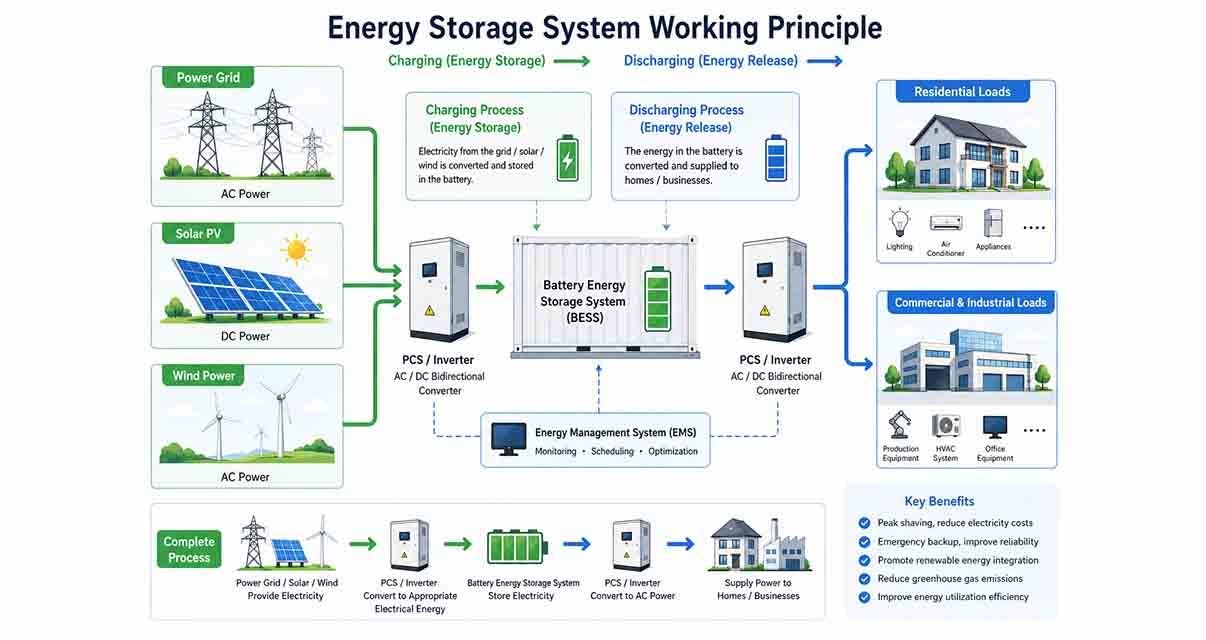
II. What are the applications of energy storage facilities? — Covering the entire process from power generation, grid, to end-users
Energy storage has diverse application scenarios, covering the entire power system lifecycle from generation to transmission, distribution, and consumption.
On the generation side, energy storage is primarily deployed in photovoltaic power plants, wind farms, and thermal power plants. Integrated renewable energy storage effectively mitigates the issue of “curtailed solar and wind power,” smoothing the volatility and intermittency of renewable energy sources such as photovoltaics and wind power. For thermal power plants, storage integration enhances peak shaving and frequency regulation capabilities, ensuring stable grid operation.
On the grid side, energy storage systems are integrated into the transmission and distribution networks and are centrally dispatched by grid operators to meet the grid’s flexibility requirements. When grid load is low, the energy storage systems absorb excess electrical energy for charging; during peak demand periods, they promptly discharge energy to supplement supply, achieving “peak shaving and valley filling” and thereby alleviating grid pressure.
On the user side, energy storage is primarily deployed in industrial and commercial applications as well as residential settings. Users leverage the price difference between peak and off-peak electricity rates for arbitrage—charging their energy storage systems during off-peak hours at night and discharging them during peak daytime hours, thereby significantly reducing electricity costs. Currently, industrial and commercial energy storage dominates the user-side market in China, with an increasing number of factories, industrial parks, and commercial buildings implementing energy storage systems to enhance energy efficiency and savings.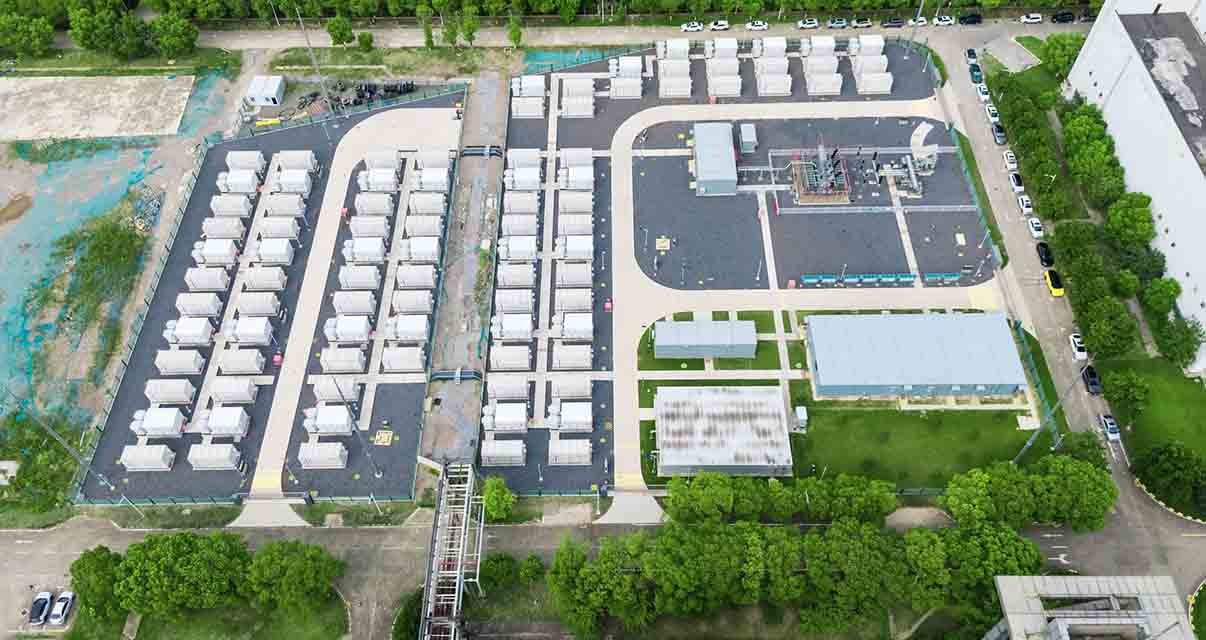
III. What is the current state of the energy storage market? — Rapid growth with broad prospects
The energy storage industry is experiencing rapid growth. Domestically, policy support continues to intensify, with the cumulative contract volume for domestic lithium battery energy storage systems in January-February 2024 rising 259.5% year-on-year, sustaining its high-growth trajectory. Globally, as energy storage technologies mature and their economic viability improves, the installed capacity is projected to reach approximately 544 GWh by 2027, representing a compound annual growth rate (CAGR) of 37.9% from 2022 to 2027.
Meanwhile, the energy storage industry is shifting from “single-dimensional” competition to “multi-dimensional value” competition. Industry experts note that future development will feature trends such as comprehensive lifecycle value restructuring, AI-powered system evolution, and accelerated global expansion of ecosystems. Energy storage is evolving from a “key support” to a “core pillar” in the energy transition strategy.
IV. Where Is Future Energy Storage Headed? — High Capacity, Intelligence, and Diversification
Looking ahead, the energy storage industry will accelerate its evolution along three key directions:
The first direction is toward large-capacity and long-duration energy storage. New energy storage technologies are rapidly evolving toward higher capacity, hybridization, and diversification. The “Roadmap for the Development of New Energy Storage Technologies” issued by the Ministry of Industry and Information Technology outlines key products and critical performance indicators for 2035 across five major domains: electrochemical energy storage, mechanical energy storage, hydrogen energy storage, and others. It is projected that China’s installed capacity for new energy storage will exceed 180 million kilowatts by 2027 and surpass 300 million kilowatts by 2035.
The second aspect is AI empowerment and intelligent upgrading. Energy storage and artificial intelligence are evolving in tandem—energy storage relies on AI for smarter and more efficient operational scheduling, while AI requires energy storage as the “ballast stone” of the new power system. AI-powered electricity trading agents will enhance electricity price forecasting accuracy, generating greater market returns for energy storage.
Third, the diversification of technological approaches. In addition to lithium-ion batteries, which currently dominate the market, various alternative technologies such as sodium-ion batteries, flow batteries, and compressed air energy storage are rapidly transitioning from laboratory settings to commercial application, offering the energy storage industry a broader range of technical options.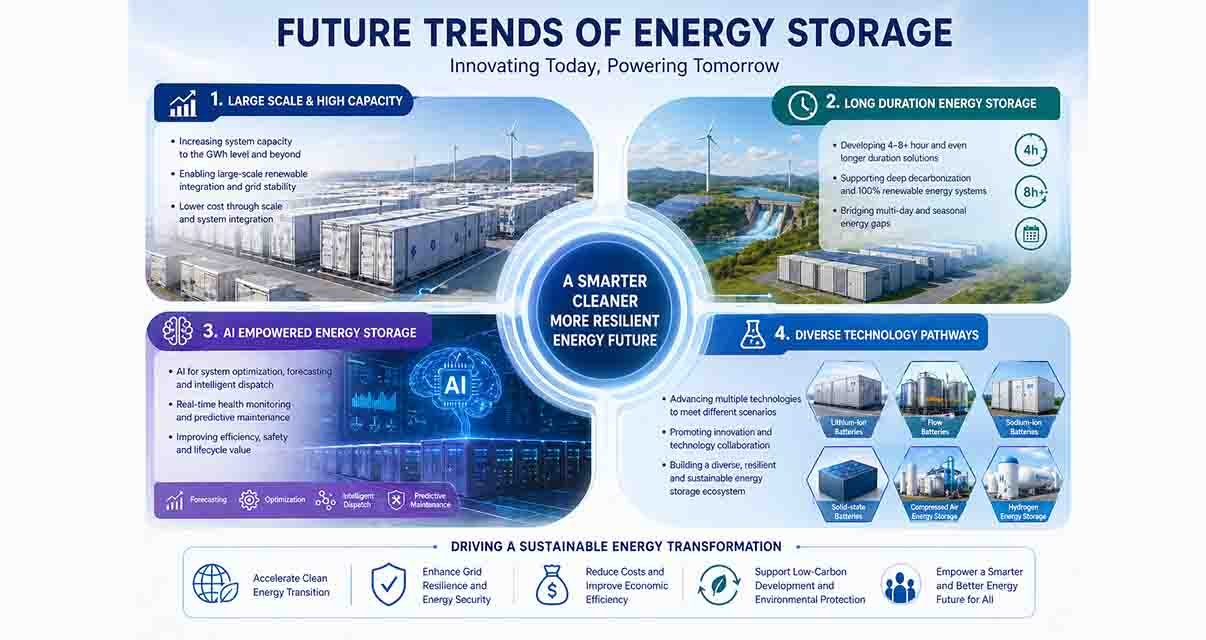
Epilogue
From being mere “power carriers” to becoming a pivotal pillar of the energy transition, energy storage is reshaping the global energy landscape. With sustained policy incentives, continuous technological breakthroughs, and steadily declining costs, the energy storage industry is entering a phase of rapid growth. Whether power generation companies, industrial and commercial users, or household consumers, all stand to benefit from this energy revolution. The future is already here, and energy storage holds immense potential.