The AIDC outbreak is reshaping the energy storage landscape: Value breakthroughs and professional opportunities in the elimination phase
At the Beijing National Convention Center in April 2026, the 14th Energy Storage International Summit and Exhibition (ESIE 2026) was permeated with a complex atmosphere—half excitement, half anxiety. The most notable change was that the large-scale energy storage solutions from the power generation and grid sectors, which had traditionally dominated the spotlight, had collectively stepped aside; nearly all leading energy storage companies allocated their most prominent booths to a single keyword: Artificial Intelligence Data Center (AIDC)-integrated energy storage.

The AIDC thermal energy storage initiative reflects the collective efforts and profound concerns of the entire energy storage industry amid intensifying competition in a highly saturated market.
Breaking Through the Red Sea: When the Price War Enters the Elimination Stage
“If 2025 marked the inaugural year of price wars in the energy storage industry, then 2026 heralds the start of the elimination phase,” remarked a senior executive from a listed energy storage company during the exhibition. “The gross profit margins for traditional energy storage projects have now plummeted to single-digit levels.”
Data shows that the average market price of energy storage cells plummeted from 0.8 yuan/Wh in early 2023 to around 0.26 yuan/Wh by mid-2025. Although prices have recently rebounded, the rise in raw material costs has failed to significantly improve gross margins, leading to a steep profit decline for multiple listed companies. The traditional energy storage market has transformed from a “blue ocean” into a “red ocean.”
The turning point signal is emerging. On March 30, the State Administration for Market Regulation issued a document explicitly addressing the prevention of “involution-style” competition in key industries such as photovoltaics and lithium batteries. The competitive logic within these industries is shifting from “price competition” to “value competition” —with cycle life, system efficiency, and intelligence levels becoming new dimensions of rivalry.
AIDC Opportunity: The Strategic Asset in the Era of Computing Power
Amid growing pressures on traditional markets, AIDC’s energy storage solutions have rapidly emerged as the industry’s most prominent growth driver. The surge in token economy has elevated energy storage from a mere backup power facility to a strategic asset in the era of computing power.
According to industry forecasts, global AI data centers will account for over 10% of total global electricity consumption by 2030, with the China market expected to achieve a compound annual growth rate exceeding 40%. This year, “computing-electricity synergy” was included in the government work report for the first time. Driven by policy measures, global demand for AIDC-accompanied energy storage is projected to double to over 40 GWh by 2026, bringing the overall market size close to $20 billion.
This deep integration of “computing power and electricity” imposes requirements far exceeding those of traditional applications on energy storage products: AIDC cabinets now deliver power outputs ranging from 10 kW to the megawatt (MW) level, while data centers expand from the MW to the gigawatt (GW) scale, with power fluctuations far exceeding those of conventional data centers. This presents comprehensive challenges to energy storage systems’ high power output, reliability, and intelligence capabilities, making technological and security capacities the core competitive differentiators.
Strategic Opportunities for Professional Energy Storage Companies
Amid the surge in AIDC-based energy storage solutions, professional energy storage enterprises with profound technical expertise and comprehensive end-to-end service capabilities are embracing unprecedented development opportunities.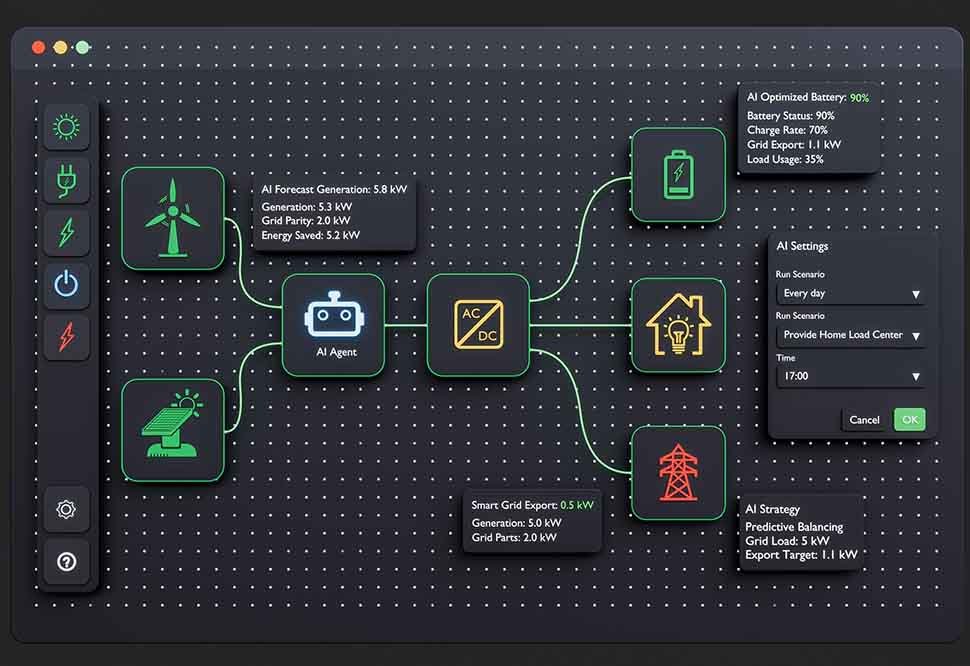
Taking an energy storage specialist with 16 years of expertise in lithium battery technology as an example, its product portfolio spans industrial and commercial energy storage, residential energy storage, golf cart batteries, drone batteries, motorcycle starter batteries, and customized lithium batteries across diverse applications. This demonstrates the company’s deep technical expertise and modular design capabilities tailored to specific use cases. Notably, the BMS (Battery Management System) software and hardware system, independently developed by an engineering team with over 15 years of experience, signifies the company’s mastery of proprietary core technologies in this critical battery management domain.
In the stringent requirements of the AIDC scenario, AIDC’s end-to-end self-developed capabilities spanning battery cells, BMS, and energy storage systems, coupled with a rigorous quality management framework, constitute its core competitive edge over players engaged solely in “price wars.” To stand out in the fiercely competitive traditional energy storage market, success has never depended on the lowest price but rather on comprehensive strengths—including optimal levelized cost of energy (LCOE) across the entire lifecycle, superior intelligent operational capabilities, and highest system safety standards. This represents the essential path for energy storage enterprises to achieve value differentiation in the AIDC era.
As computing power and electricity become deeply integrated, the energy storage industry is evolving from a policy-driven ‘cost center’ into a market-driven ‘value hub,’ marking a profound restructuring of industrial value.